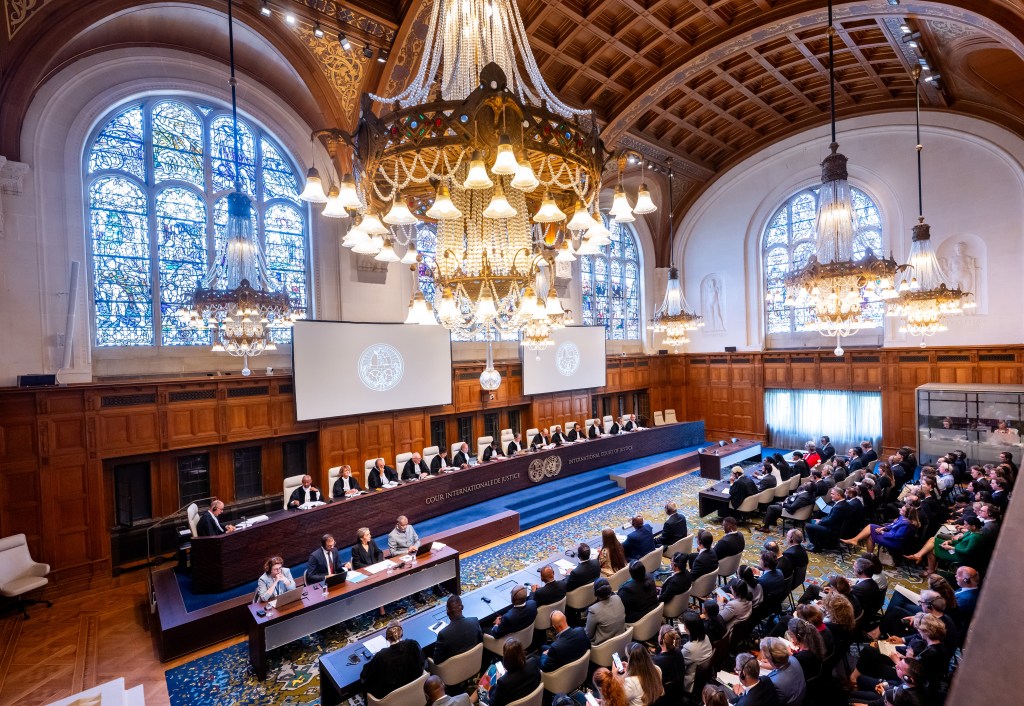
The International Court of Justice (ICJ or Court) is the biggest international court in the world – the judicial organ of the United Nations. But what does it mean when it talks about justice? Especially considering that it claims to be the court of justice. A few weeks ago, the Court rendered an advisory opinion about the Obligations of States concerning Climate Change. Since, for my MA thesis, I studied the concept of justice of the ICJ in two key cases, out of curiosity, I took a look at it, and I wanted to write a brief comment.
DISCLAIMER: I’m not a lawyer. Not even trained in international law. My MA used the lens of conceptual history and blended philosophy, history, and international law. For the thesis, I studied the Corfu Channel case (1949, the first contentious case of the Court) and the Namibia case (1971). So my comment will take them as references to assess the concept of justice in this specific case.
The advisory opinion of the Court stated that states have obligations to protect the environment and prevent harm to it, as well as the duty to reduce climate change, including reducing emissions. But the outcome of the ruling is actually irrelevant for us. What I found interesting is how the argument of the Court is built. It is interesting to look at the material the Court used to render the judgment. As we know, law is always self-referential, and past judgments are recalled and used as a basis for new formulations.
Nowadays, like many other people, I think that this is not a good period for justice. Both for justice and International law. However, in the Climate Change opinion, there seems to be a development in how justice is thought – and this is a good sign.
A first point regards the notion of equity. I find it interesting that the concept of justice is now explicitly associated with the notion of equity. That did not happen in the late 40s and 70s, even though it was indeed assumed that justice meant having equity, expressed, for instance, in solving power imbalances. In the cases I studied more carefully, equity was just assumed, kind of implied, but not explicitly formulated as an expression of justice.
152. Many participants referred to equity, displaying different understandings of this concept. In the Continental Shelf (Tunisia/Libyan Arab Jamahiriya) case, in which the relevant special agreement relating to maritime delimitation called on the Court to take account of equitable principles, the Court affirmed that “[e]quity as a legal concept is a direct emanation of the idea of justice” and “the legal concept of equity is a general principle directly applicable as law” (Judgment, I.C.J. Reports 1982, p. 60, para. 71)
Climate Change advisory opinion, page 53-54, paragraph 152
In this passage of the advisory opinion, the Court actually recalls a case where it had already explicitly expressed this association, and that was in 1982. It also refers to a list of cases where the Court considered equity as a legal principle, and they basically start from the late 60s. I wonder if it did the same in those same cases, that is, if it recalled other cases where thinking about equity was important for the ruling. I’m not 100% sure, but I really doubt that it did so. At least, I’m quite sure that justice was not repeatedly associated with equity, in the sense that the word justice was not used – as a methodological choice, in my thesis I looked for the specific appearance of the word justice, and I know that in like every case from the 90s onwards they did not mention justice at all. In addition, the same paragraph quoted here already suggests that dedicating a section of the present ruling to equity was prompted by the participants’ reference to the concept of equity. From this, I deduce that the notion of equity is gaining more and more relevance and recognition as an expression of justice.
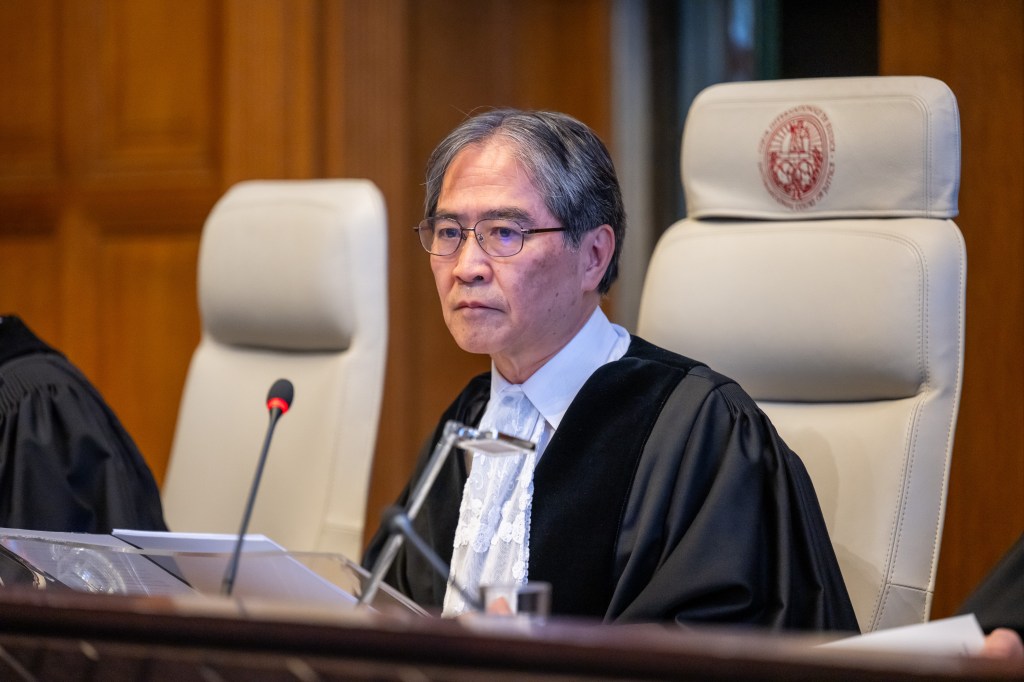
Moreover, another element to discuss is the idea of intergenerational equity. This idea is discussed right after the section about equity, in the ruling. The combination of equity and intergenerationality is particularly interesting because the latter is a specific expression of time.
In this context, “intergenerationality” means caring for the next generation, and the concept already appeared in the Paris Agreement (2015), which is also recalled by the Court in the ruling. The definition of the Court:
156. Intergenerational equity is an expression of the idea that present generations are trustees of humanity tasked with preserving dignified living conditions and transmitting them to future generations.
Climate Change advisory opinion, page 55, paragraph 156
Wow. The fact that the ruling builds on these concepts – equity and intergenerationality – I’d argue, is quite a turn in the concept of justice of the Court. Talking about intergenerational equity, like intergenerational justice, implies a future-oriented way of reasoning. A way of thinking that includes the future in itself. In fact, future generations are taken into account.
Thinking with the future in mind, so to speak, can also happen in other ways. In the Corfu Channel case, the Court formulated its judgment in a way that aimed to prevent an event from happening in the future. So the future was “embedded” in the ruling and thinking of the Court. This is something I argued in my thesis, by the way. Another future-oriented way of reasoning is the Soviet Judge Krylov, in the Namibia Case (1973), who wants to reduce the jurisdiction of the Court, because he wants to avoid repercussions for the Soviet Union itself. The future possibility of damaging the Soviet Union is taken into account by the judge.
The Court, in the Climate Change opinion, recalls, while writing about intergenerational equity, the advisory opinion of 1996, Legality of the Threat or Use of Nuclear Weapons. That was a key case that I think marked a turning point as the concept of Future Justice started to develop. In that case, the harm to future generations was very relevant for the reasoning of the Court. Indeed, the “future” was explicitly mentioned for the first time, and this is why the Court in the Climate Change case recalled that same ruling.
The fact that in the present ruling, equity and the future are given that weight is not few as it is not the norm. This is not the usual because some judges might be focused more on the present, so trying to solve a present issue, without giving too much importance to what comes next (the future). This same historical period seems indeed marked by the urgency to find quick legal solutions, for example, for emerging technologies. Dedicating a space to think about the future is relevant, and it is important how it seems to have been built through the years. Past rulings are recalled to argue and support the relevance of intergenerational equity. In the Climate Change ruling, a future-oriented way of reasoning is for sure more consolidated, meaning that it builds on past rulings and affirms and perpetuates some aspects of them.
In conclusion, I’d say that in the future we can expect more and more rulings with this kind of future-oriented approach, as every judgment serves as a basis for future rulings. To the same extent in which the ICJ, in the climate change opinion, referred to past cases concerning equity or intergenerationality, in the future it could refer to the Climate Change case, where these same concepts are crucial and argued to a greater extent compared to the previous cases of the Court.
 Daniele Balducci
Lascia un commento